



Santander emerges as Northern Spain’s leading cultural destination
The capital of Cantabria prepares for a landmark cultural year with major museum openings in 2026.
The capital city of Cantabria, located on Spain’s northern coast, has undergone a significant transformation in recent years driven by major cultural initiatives such as the Botín Centre, designed by Pritzker Prize-winner Renzo Piano and inaugurated in 2017, and the ENAIRE Collection of contemporary art, opened in 2021. This momentum will continue and culminate in 2026, as three key projects will be completed, marking an important step in the consolidation of Santander’s cultural identity.
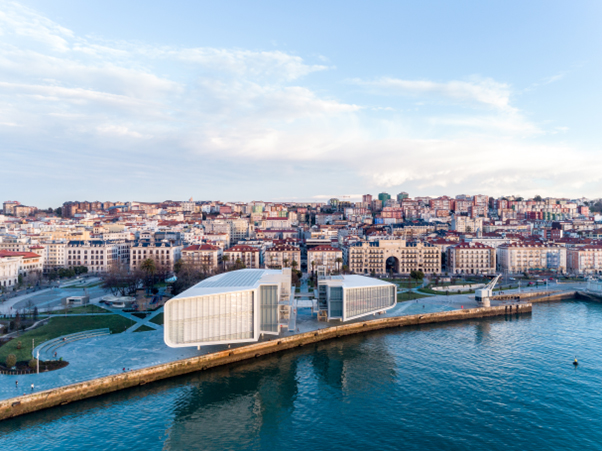
Chief among these projects is Faro Santander, Banco Santander’s new art initiative housed in the institution’s former headquarters, one of the city’s most notable buildings located directly opposite the Botín Centre. Developed under the direction of Pritzker Prize-winning architect David Chipperfield, the project will place two Pritzker laureates within the same urban area of Santander. In parallel, this cultural axis will be further strengthened by the opening of a new venue of the Reina Sofía Museum, reinforcing the city’s emerging cultural corridor in 2026. At the same time, the Museum of Prehistory and Archaeology of Cantabria (MUPAC) will relocate to a new, expansive site in the city centre, underscoring the importance of the region’s prehistoric heritage.
Together, these cultural centres will strengthen Santander’s position as a cultural destination, offering one of the highest concentrations of museum and artistic institutions in northern Spain.
Santander introduces visitors to the wider region of Cantabria, whose outstanding natural, historical, and cultural assets range from the Museo Nacional de Altamira, highlighting the most iconic of the region’s ten UNESCO World Heritage caves, to architectural treasures such as Gaudí’s El Capricho.
Hidden gems to discover a less traveled Cantabria
Nature, history, and tranquility come together in five unique destinations across northern Spain’s Cantabria region
Nestled among mountains, caves, and valleys, Cantabria is home to some hidden gems left untouched by mass tourism, where nature reveals itself at its most pristine. From trails winding through endless beech forests to unusual sanctuaries and timeless beaches, Cantabria invites you to explore a more intimate, authentic side of the region- a leisurely journey through secret landscapes, rich traditions, and tranquil silence. Visitors venturing into the El Soplao Cave will quickly understand why it’s known as the Sistine Chapel of Geology. Situated between Valdáliga and Rionansa, it captivates with its eccentric formations, crystalline galleries, and mysterious underground atmosphere. Beyond the standard tour, an adventure route leads visitors to explore areas in their natural, untouched state, equipped with helmet and headlamp, for an experience as thrilling as it is unforgettable.
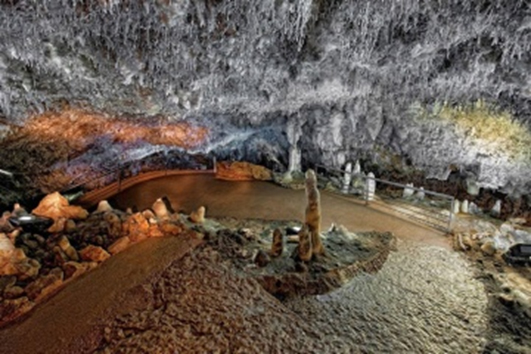
El Soplao is a mining term that refers to the rush of air felt when drilling from one gallery to another with less oxygen. Today, the entire route is fully wheelchair accessible.
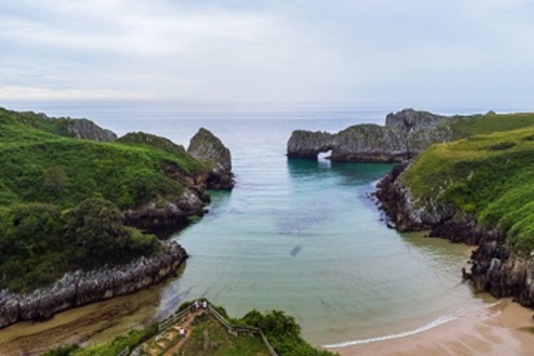
A short distance away, amid a unique environment, lies the San Román de Moroso Hermitage, in Bostronizo (within Arenas de Iguña), one of the best-preserved pre-Romanesque churches in northern Spain. Nestled among oaks and steeped in legend, its setting appears to have been made for quiet reflection. Visitors who make the journey here will discover not just a 10th-century architectural gem, but also a spiritual sanctuary embraced by the forest. At the heart of the Pasiego Valleys, Alto del Caracol presents one of Cantabria’s most breathtaking panoramic viewpoints. Here, the road winds upwards through meadows and traditional cabins, reaching a vantage point from which the landscape unfolds into an endless chain of valleys. The Pasiegos, heirs to a pastoral mountain lifestyle, perpetuate a way of life that embodies the region’s most authentic identity. Meanwhile, the coastline has plenty of secrets to share too. On the western coast, Berellín Beach, near Prellezo (in Val de San Vicente), lies tucked away among cliffs and rock formations that reveal a natural turquoise lagoon at low tide. Further east, Antuerta Beach, near Ajo (in Bareyo), retains its wild, untouched charm-with no facilities or crowds-while Oyambre combines dunes, meadows, and open sea within a serenely beautiful protected area. Berellín Beach, located on the western coast, is renowned for its stunning natural beauty and striking karst formations.
For those eager to escape inland, the Saja-Besaya Nature Park is a real green lung, stretching out over the heart of Cantabria. Its beech forests -some of the largest in northern Spain—are home to wildlife such as roe deer and wolves, and feature well-marked trails like the Pozo de la Arbencia route. This is the perfect place for leisurely walks, listening to the forest, and discovering why Cantabria remains synonymous with vibrant nature. Location Cantabria is situated in northern Spain, between the Cantabrian Sea, Asturias, Castile and León, and the Basque Country. It is well connected via the A-8 and A-67 motorways, served by Seve Ballesteros-Santander Airport and the port of Santander, and offers Renfe train services to Madrid, Bilbao, and Oviedo.




Gallery




Subscribe to our E-Zine
from latest edition

Music City Presents Travel-Worthy Lineup of Winter Events and Budget-Friendly Offers
As we kick off 2026, there's never been a better time to visit Nashville than February. Beyond the winter specials, deals, and discounts from Nashville businesses, Music City offers unforgettabl...
Read more
Florida’s Space Coast Melbourne & The Beaches: Visitors discover family-friendly adventures
Families travelling to Florida’s Space Coast will find that Melbourne & the Beaches offers a welcoming blend of sun-drenched shoreline, nature encounters and adventure-filled activities - making...
Read more
Turkish Airlines Signs Three Year Title Partnership for Turkish Airlines Open
Turkish Airlines, the airline that flies to more countries than any other, has signed a new three-year title sponsorship for the prestigious Turkish Airlines Open golf tournament. The tournament...
Read more
Leadership change in Mallorca’s Tourism Department: Guillem Ginard takes office
The Consell de Mallorca has appointed Guillem Ginard as the new Minister of Tourism, succeeding former minister Marcial Rodríguez, following a change in the leadership of the department on 31st ...
Read more
The Mexican Caribbean Awaits: Aer Lingus’ New Direct Flight from Dublin to Cancún takes off!
Aer Lingus’ first direct flight to Cancún, Mexico, took off today. The new route from Dublin to Cancún will operate 3 times weekly on the airline’s A330-300 aircraft, offering Irish holidaymaker...
Read more
Looking forward to your next chapter Orla Milton, 28 Years. One Incredible Journey.
From everyone at Travelbiz and our trade partners who’ve had the pleasure of working with you, this is a heartfelt tribute to an exceptional career.
After almost three decades with Crystal...